
Babysitting and minimum wage in 2027: what the law says and what sitters actually earn
The law mostly leaves babysitters alone. The minimum wage still sets their price.
The short answer: most babysitters are not legally owed minimum wage. Federal law exempts anyone who babysits "on a casual basis", which usually means 20 hours a week or less and not as your main job. Only four states clearly cover occasional sitters anyway. But the going rate for a babysitter is still 1.3 to 3.2 times the minimum wage in every state, and in 13 states that floor goes up on 1 January 2027. The law mostly leaves you alone. The minimum wage still sets your price.
Key takeaways
- An occasional babysitter is clearly covered by state minimum wage law in only 4 states: New Jersey, Rhode Island, New Mexico and Nevada. Four more cover some sitters past an age or hours line.
- The typical rate for one child runs from 1.30x the 2027 minimum (Connecticut, Nebraska) to 3.16x (New Hampshire). The median state is 1.74x.
- Michigan's floor jumps 9.2% on 1 January, the biggest rise of the 13 states going up. New York's is frozen.
- In 30 states, the common "half rate while they sleep" overnight pays less per hour than the state minimum wage.
- The $3,000 "nanny tax" threshold is a tax rule. It has nothing to do with whether minimum wage applies.
Do babysitters have to be paid minimum wage?
Usually not. The Fair Labor Standards Act lists babysitters as domestic workers, then carves out an exemption for "employees employed on a casual basis in domestic service employment to provide babysitting services". A casual babysitter is exempt from both the federal minimum wage and overtime.
The Department of Labor's regulation spells out what casual means. Under 29 CFR 552.5, the work has to be irregular or intermittent, and babysitting can't be your vocation. 29 CFR 552.104 adds the number most people need: babysitting is generally casual if it adds up to 20 hours a week or less across all the families you work for. It names the people Congress had in mind, teenagers sitting outside school hours and people who don't depend on the income.
That's why the internet gives two opposite answers. The Department of Labor's own youth wage page says babysitting isn't covered by minimum wage law, full stop. Care.com's guide to paying caregivers minimum wage says household workers must get at least the minimum. Both are describing a real rule. Neither mentions where one ends and the other starts, and that line is the 20 hours and the "is this your job" question.
Federal coverage for household workers also needs a minimum amount of work before it kicks in at all. Under 29 USC 206(f), a domestic worker is covered if one employer pays enough to count as wages for Social Security, which is $3,000 in 2026, or if they work more than 8 hours a week in total. A sitter who does two Saturday nights a month for one family clears neither bar.
Every state's 2027 minimum wage vs the going babysitting rate
Whether or not the law reaches you, families and sitters use the minimum wage as a reference point. "That's barely more than minimum wage" is a sentence sitters hear when they quote a rate, and it's one they think when they get offered one. So here's every state's floor for 2027 set against what a sitter there typically charges for one child, using the state rates behind our babysitting rate calculator.
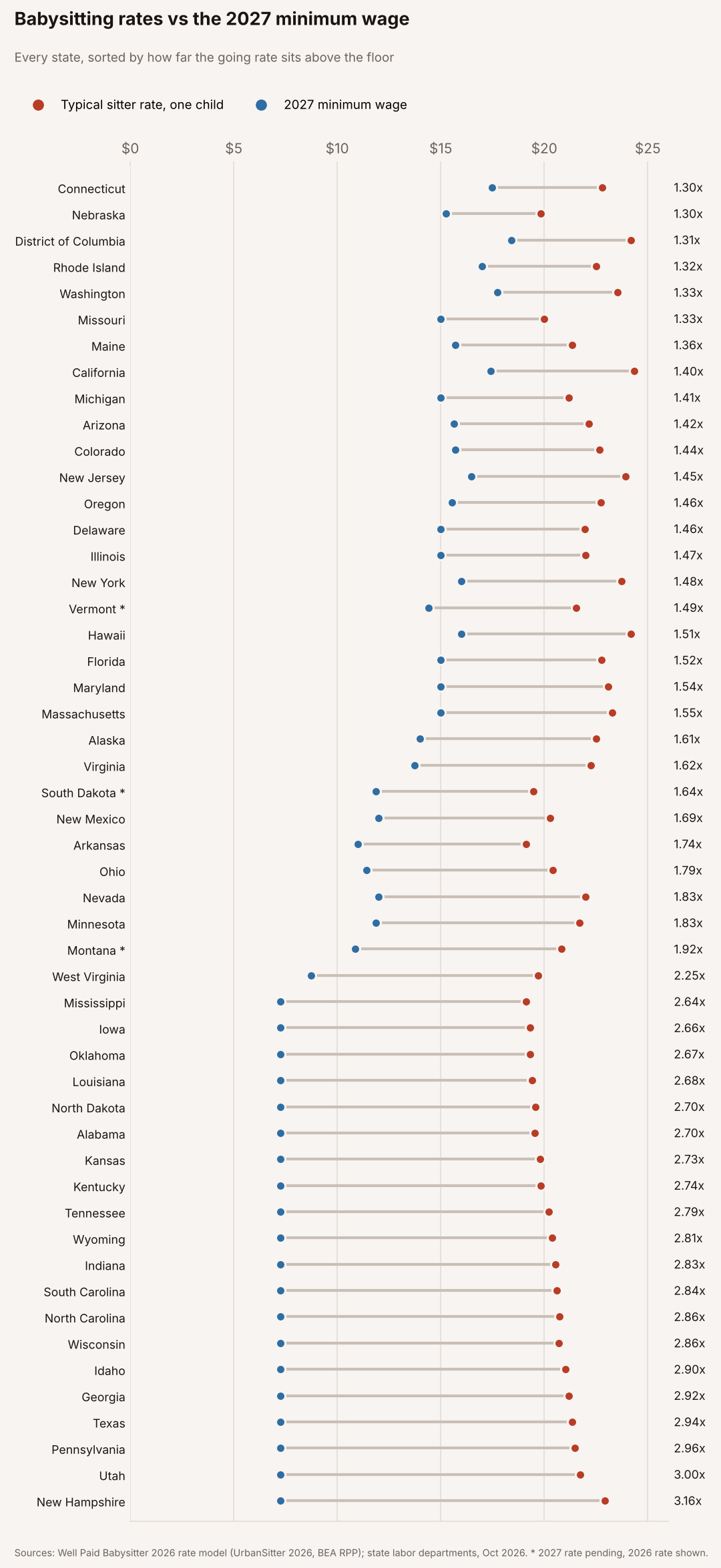
The pattern is two groups. The 20 states that sit at the federal $7.25 floor (minimum wage hasn't changed federally since 2009) have sitter rates about 2.6 to 3.2 times the minimum. Everywhere with its own higher floor, the gap shrinks fast. In Connecticut, Nebraska, DC, Rhode Island, Washington and Missouri, the minimum wage is already three quarters of what a sitter typically charges.
That squeeze matters because the floor is what the other jobs pay. A 17-year-old in Washington can make $17.73 an hour at a grocery store from January. Sitting for one child at $23.54 still beats that, but not by much once you count the evenings, the responsibility and the lack of guaranteed hours. When sitter rates jumped in 2022, CBS reported that teens were taking jobs at restaurants and other businesses instead.
| State | Typical sitter rate (1 child) | Minimum wage 2026 | Minimum wage 1 Jan 2027 | Rate as a multiple of the floor | State law covers occasional sitters? |
|---|---|---|---|---|---|
| Alabama | $19.54 | $7.25 | $7.25 | 2.70x | No (federal rules) |
| Alaska | $22.52 | $14.00 | $14.00 (next change 1 Jul 2027) | 1.61x | No |
| Arizona | $22.15 | $15.15 | $15.65 (reported, not yet official) | 1.42x | No |
| Arkansas | $19.13 | $11.00 | $11.00 | 1.74x | No |
| California | $24.36 | $16.90 | $17.40 | 1.40x | Some sitters |
| Colorado | $22.67 | $15.16 | $15.71 | 1.44x | No |
| Connecticut | $22.79 | $16.94 | $17.48 | 1.30x | No |
| Delaware | $21.96 | $15.00 | $15.00 | 1.46x | No |
| District of Columbia | $24.18 | $18.40 | $18.40 (next change 1 Jul 2027) | 1.31x | No |
| Florida | $22.75 | $15.00 | $15.00 (rose 30 Sep 2026) | 1.52x | No (federal rules) |
| Georgia | $21.18 | $7.25 | $7.25 | 2.92x | No (federal rules) |
| Hawaii | $24.19 | $16.00 | $16.00 | 1.51x | No |
| Idaho | $21.01 | $7.25 | $7.25 | 2.90x | No (federal rules) |
| Illinois | $21.99 | $15.00 | $15.00 | 1.47x | Some sitters |
| Indiana | $20.53 | $7.25 | $7.25 | 2.83x | No (federal rules) |
| Iowa | $19.31 | $7.25 | $7.25 | 2.66x | No |
| Kansas | $19.81 | $7.25 | $7.25 | 2.73x | No (federal rules) |
| Kentucky | $19.83 | $7.25 | $7.25 | 2.74x | No |
| Louisiana | $19.41 | $7.25 | $7.25 | 2.68x | No (federal rules) |
| Maine | $21.35 | $15.10 | $15.70 | 1.36x | Unclear |
| Maryland | $23.09 | $15.00 | $15.00 | 1.54x | Unclear |
| Massachusetts | $23.27 | $15.00 | $15.00 | 1.55x | Unclear |
| Michigan | $21.17 | $13.73 | $15.00 | 1.41x | No |
| Minnesota | $21.70 | $11.41 | $11.87 | 1.83x | No |
| Mississippi | $19.13 | $7.25 | $7.25 | 2.64x | No (federal rules) |
| Missouri | $19.98 | $15.00 | $15.00 | 1.33x | No |
| Montana | $20.82 | $10.85 | Pending | 1.92x (on 2026 floor) | No |
| Nebraska | $19.82 | $15.00 | $15.26 (reported, not yet official) | 1.30x | No |
| Nevada | $22.00 | $12.00 | $12.00 | 1.83x | Yes |
| New Hampshire | $22.92 | $7.25 | $7.25 | 3.16x | No (federal rules) |
| New Jersey | $23.94 | $15.92 | $16.48 | 1.45x | Yes |
| New Mexico | $20.29 | $12.00 | $12.00 | 1.69x | Yes |
| New York | $23.74 | $16.00 | $16.00 (NYC, Long Island, Westchester $17.00) | 1.48x | No |
| North Carolina | $20.75 | $7.25 | $7.25 | 2.86x | No |
| North Dakota | $19.57 | $7.25 | $7.25 | 2.70x | No (federal rules) |
| Ohio | $20.41 | $11.00 | $11.40 | 1.79x | No |
| Oklahoma | $19.33 | $7.25 | $7.25 | 2.67x | No (federal rules) |
| Oregon | $22.74 | $15.55 | $15.55 (next change 1 Jul 2027) | 1.46x | No |
| Pennsylvania | $21.47 | $7.25 | $7.25 | 2.96x | No (federal rules) |
| Rhode Island | $22.50 | $16.00 | $17.00 | 1.32x | Yes |
| South Carolina | $20.62 | $7.25 | $7.25 | 2.84x | No (federal rules) |
| South Dakota | $19.49 | $11.85 | Pending | 1.64x (on 2026 floor) | No |
| Tennessee | $20.21 | $7.25 | $7.25 | 2.79x | No (federal rules) |
| Texas | $21.35 | $7.25 | $7.25 | 2.94x | No (federal rules) |
| Utah | $21.75 | $7.25 | $7.25 | 3.00x | No |
| Vermont | $21.55 | $14.42 | Pending | 1.49x (on 2026 floor) | No |
| Virginia | $22.24 | $12.77 | $13.75 | 1.62x | Some sitters |
| Washington | $23.54 | $17.13 | $17.73 | 1.33x | No |
| West Virginia | $19.69 | $8.75 | $8.75 | 2.25x | No |
| Wisconsin | $20.70 | $7.25 | $7.25 | 2.86x | Some sitters |
| Wyoming | $20.39 | $7.25 | $7.25 | 2.81x | No (federal rules) |
"Typical sitter rate" is our state rate for one child with an adult sitter of one to three years' experience. Use the calculator to add more children, late nights and your own experience. A multiple below 1.5x means the minimum wage is already a large share of the going rate.
The 13 states rising on 1 January
Thirteen states raise their floor on 1 January 2027. Most are indexed to inflation, which is why the announcements dribbled out from August to the end of September. The biggest jump is Michigan, going from $13.73 to $15.00 under its scheduled steps. Virginia goes to $13.75, after a bill signed in April that takes it to $15.00 in 2028. Washington becomes the highest state at $17.73.
| State | 2026 floor | 2027 floor | Increase | Typical sitter rate now | Rate that keeps the same lead |
|---|---|---|---|---|---|
| Michigan | $13.73 | $15.00 | 9.2% | $21.17 | $23.13 |
| Virginia | $12.77 | $13.75 | 7.7% | $22.24 | $23.95 |
| Rhode Island | $16.00 | $17.00 | 6.3% | $22.50 | $23.91 |
| Minnesota | $11.41 | $11.87 | 4.0% | $21.70 | $22.57 |
| Maine | $15.10 | $15.70 | 4.0% | $21.35 | $22.20 |
| Ohio | $11.00 | $11.40 | 3.6% | $20.41 | $21.15 |
| Colorado | $15.16 | $15.71 | 3.6% | $22.67 | $23.49 |
| New Jersey | $15.92 | $16.48 | 3.5% | $23.94 | $24.78 |
| Washington | $17.13 | $17.73 | 3.5% | $23.54 | $24.36 |
| Arizona | $15.15 | $15.65 | 3.3% | $22.15 | $22.88 |
| Connecticut | $16.94 | $17.48 | 3.2% | $22.79 | $23.52 |
| California | $16.90 | $17.40 | 3.0% | $24.36 | $25.08 |
| Nebraska | $15.00 | $15.26 | 1.7% | $19.82 | $20.16 |
The last column is the useful one. If your rate was fair against the 2026 floor, it's the rate that keeps the same lead in 2027. A Michigan sitter charging $21.17 needs about $23.13 to hold her ground. Nobody is legally owed that raise. It's simply what standing still costs.
Arizona's $15.65 and Nebraska's $15.26 have so far only been reported in the press (KAWC, KLIN). They're in the table, but treat them as provisional until the state notices appear. Montana, South Dakota and Vermont announce by mid October.
New York's frozen floor, and Florida's $15
Two states move the other way. New York won't raise its minimum on 1 January. An inflation off-ramp in the law kicked in, so New York City, Long Island and Westchester stay at $17.00 and the rest of the state at $16.00. Florida already moved: it reached $15.00 on 30 September 2026, the last of the steps voters approved in 2020. Its first inflation-adjusted rate takes effect on 1 January 2028.
Does minimum wage apply to you? The casual babysitter test
Four questions settle it for most people. Answer them in order.
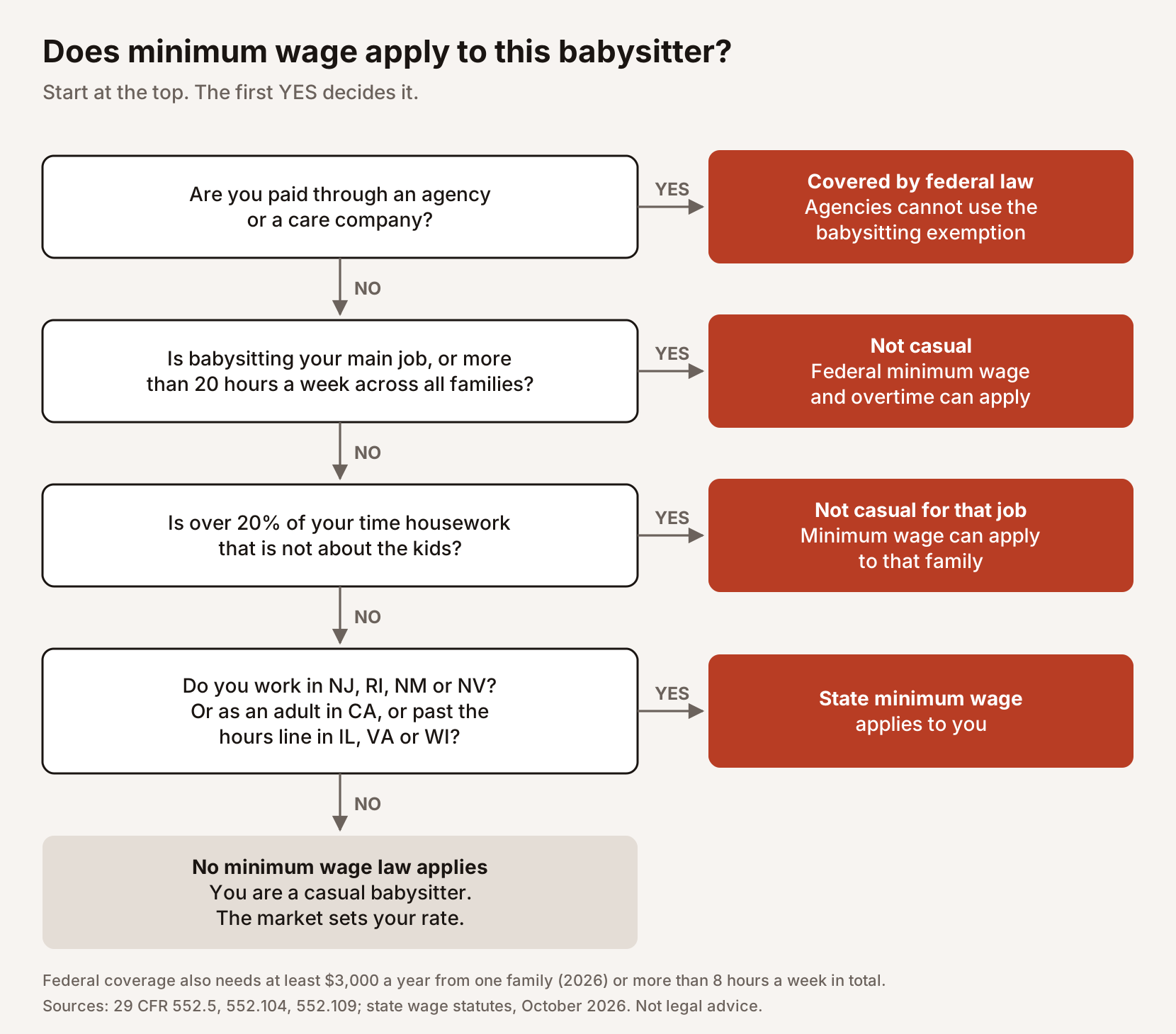
A few details the diagram compresses:
- Agencies can't use the exemption. Under 29 CFR 552.109, only the family can claim the casual babysitting exemption. A company that employs sitters and sends them out has to pay at least minimum wage.
- The 20 hours is across every family. Three families at eight hours each is 24 hours, and you're probably not casual any more.
- Chores count against you. If more than 20% of your hours go on housework that isn't about the children, 552.5 says that job isn't casual babysitting. Doing the kids' dinner dishes is fine. Cleaning the house while they nap is not.
- Summer is a special case. Under 552.104, childcare during a family's vacation can stay exempt for up to six weeks a year if the sitter isn't otherwise a domestic worker.
The states that cover babysitters anyway
States can go further than federal law, and a few have. Most have gone the other way: plenty of state wage laws name babysitters specifically so they can exclude them. Connecticut's definition of an employee leaves out "any individual engaged in baby sitting", with no hours limit at all.
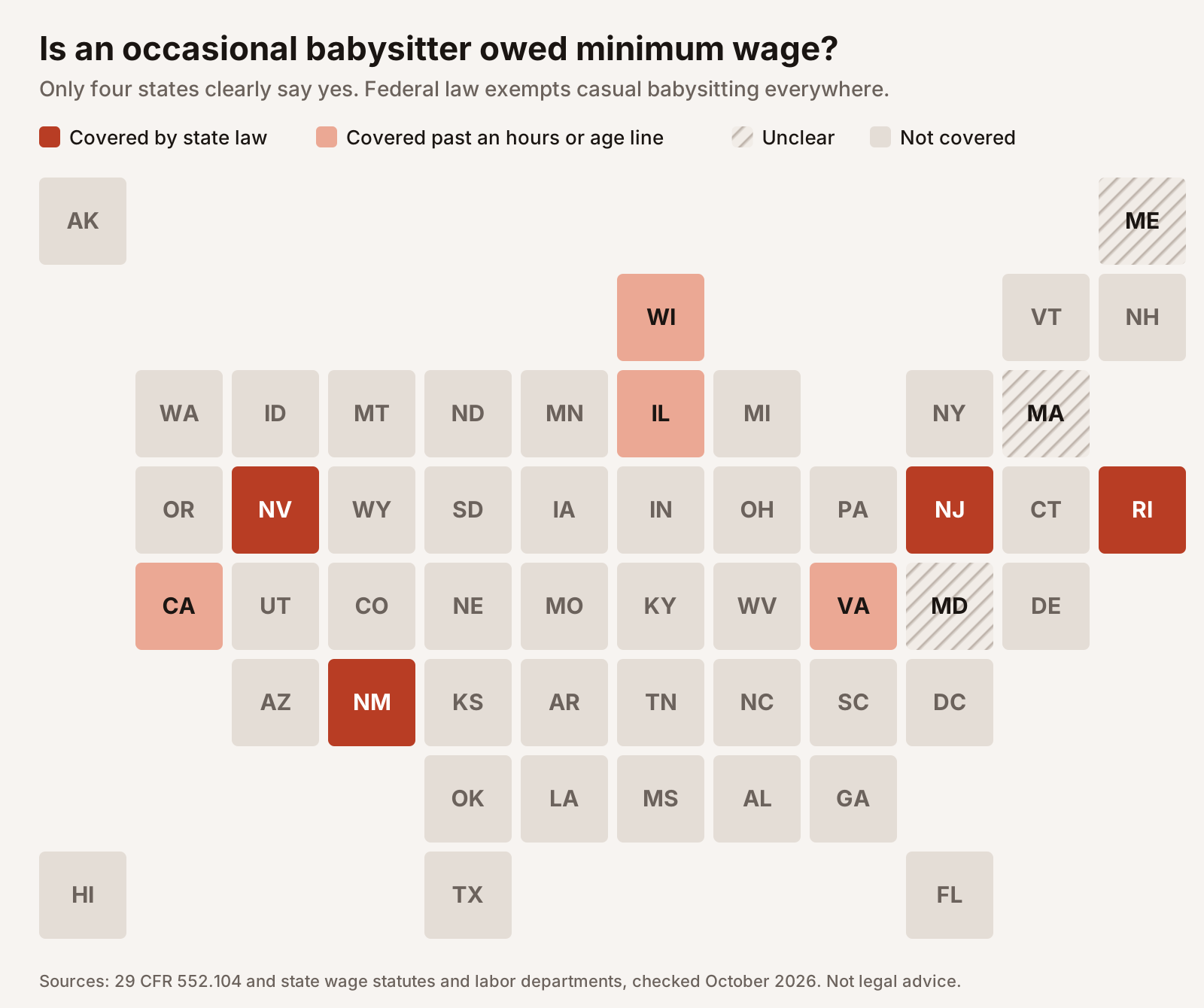
Where the law does reach a casual sitter:
- New Jersey removed its exemption for part-time childcare in the employer's home in a law approved in January 2024. The floor there is $16.48 from 1 January.
- Rhode Island repealed its domestic service exemption in 2024; only family members are left out now, per the state labor department. Its floor rises to $17.00.
- New Mexico dropped its domestic service exclusion in 2019.
- Nevada still has a casual babysitter exemption on the books, but a 2014 state supreme court ruling on the minimum wage amendment appears to have invalidated it. Check with the Labor Commissioner before relying on it either way.
And where it reaches some sitters:
- California covers adult babysitters. Wage Order 15 excludes sitters under 18 who are watching the employer's own children in the employer's home.
- Illinois extends its wage law to domestic workers through the Domestic Workers' Bill of Rights, which covers people who regularly work more than 8 hours a week in total.
- Virginia leaves out babysitters working fewer than 10 hours a week, so a regular after-school sitter can be covered.
- Wisconsin exempts casual babysitting, defined by hours per employer. Its state floor is the federal $7.25 anyway.
Maine, Maryland and Massachusetts didn't have a clear answer in the statutes we read. Massachusetts is worth knowing about if you do overnights, because its domestic worker guide describes casual sitters as generally working under 16 hours a week, and its domestic worker regulations count sleep as working time on shifts of 24 hours or more for covered workers, unless there's a written agreement saying otherwise.
Sleeping hours: where "half rate" breaks the floor
The single most argued-about babysitting question online is whether to pay full rate while the kids are asleep. In February, a sitter on r/Babysitting said she'd been offered $15 an hour awake and $5 an hour asleep for an overnight, and the thread drew around 400 comments in six days. In September, a TikTok dispute went the rounds over a sitter who asked $192 for eight hours and was paid $120 because the child slept for three of them.
The usual compromise is half rate for sleeping hours. Run that through the 2027 floors and it stops looking like a compromise.
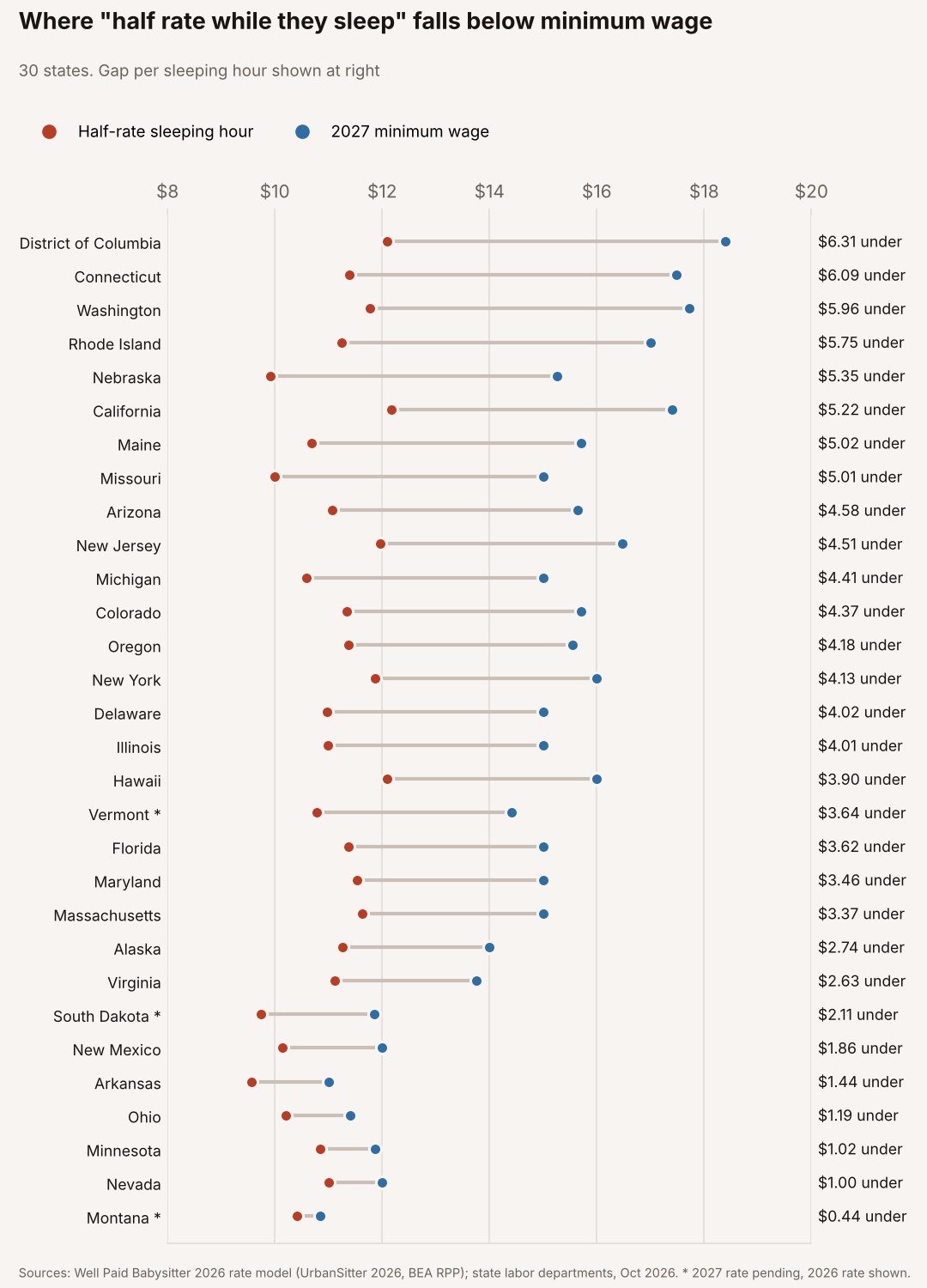
A worked example, using Washington. Our overnight model treats a typical night as five awake hours and ten sleeping hours.
| Awake: 5 hours | Asleep: 10 hours | Night total | |
|---|---|---|---|
| Half rate while asleep | 5 × $23.54 = $117.70 | 10 × $11.77 = $117.70 | $235.40 |
| Sleeping hours at the 2027 minimum | 5 × $23.54 = $117.70 | 10 × $17.73 = $177.30 | $295.00 |
That's $59.60 a night. For most sitters it isn't a legal question, because a casual overnight is exempt. For the ones who are covered, it can be. Under federal rules for covered domestic workers, sleep time can only be left unpaid on shifts of 24 hours or more, by agreement, and only if the worker actually gets at least five hours of sleep. On a 15-hour overnight, every hour counts.
Our view: price sleeping hours at a reduced rate if you like, but never below your state's minimum wage. You're still the person who gets up at 2am, and nobody else could be hired for that hour for less. That's the rule our overnight numbers already follow.
Teen sitters and youth wages
Teen sitters are where the gap with the minimum wage is widest and the law is least involved. UrbanSitter puts teen sitters at roughly $8.50 to $17 an hour. Our model prices a first-year sitter aged 12 to 14 at 70% of the adult rate, and in ten states that lands below the 2027 minimum. In California, it's $17.05 against a $17.40 floor.
Almost none of that is illegal. A 13-year-old sitting on Saturday nights is a textbook casual babysitter, and California's own wage order excludes under-18 sitters. But it's worth knowing what the floor says an hour is worth. Washington, for one, sets a $15.07 minimum for 14 and 15 year olds in 2027 for other jobs. A 15-year-old who can earn that at the pool will want close to it to give up a Friday night. Sitters aged 15 to 17 in our model clear the adult floor in every state.
Minimum wage is not the nanny tax
The other number that gets mixed into this is $3,000. That's the 2026 threshold in IRS Publication 926: if one family pays a household worker $3,000 or more in the year, the family generally owes Social Security and Medicare tax on those wages. Sitters who were under 18 at any point in the year are exempt unless childcare is their main job.
It's a tax rule, not a wage rule. Crossing $3,000 doesn't make you entitled to minimum wage, and staying under it doesn't make a below-minimum rate legal if you're a covered worker. Several older guides still quote outdated thresholds; FindLaw's piece on hiring a kid to babysit still cites a $1,900 figure from years ago. The 2027 threshold is due from the Social Security Administration in October.
What to charge in 2027: the two floor checks
You don't need the law to set your rate. You need two checks against the floor, and you can do both in a minute.
Check one: keep pace. If your state's minimum wage goes up on 1 January, raise your rate by at least the same percentage. That's 9.2% in Michigan, 6.3% in Rhode Island, 3.5% in Washington and New Jersey. Use the keep-pace table above, and send the increase to your regular families before the holidays, not after.
Check two: no hour below the floor. Not a sleeping hour, not a "the kids were easy tonight" hour, not a family discount hour. If any part of a job pays less than the state minimum, the job is underpriced, whatever the law says about your status.
If you pass both, your number is probably sound. To build it from scratch, our rate calculator starts from your state and adds children, late nights and experience. The rates chart shows the same numbers on one page, and if you're working full time for one family, the nanny salary guide is the one that applies.
The free calculator builds your rate from your area, your experience, the ages and how many children. Two minutes, no card.
Work out my rateCommon questions
Do babysitters have to be paid minimum wage?
Not if they babysit on a casual basis, which federal rules generally treat as 20 hours a week or less and not as a main job. New Jersey, Rhode Island, New Mexico and Nevada cover occasional sitters under state law, and California, Illinois, Virginia and Wisconsin cover some.
Is it legal to pay a 14-year-old babysitter $10 an hour?
In most states, yes, because occasional teen babysitting is exempt from minimum wage law. In New Jersey and Rhode Island the state minimum can apply. Whether it's fair is a different question: $10 is well under the going rate in every state.
Do you have to pay a babysitter for sleeping hours?
For a casual sitter, it's a matter of agreement, not law. For a covered domestic worker, federal rules only allow unpaid sleep on shifts of 24 hours or more, by agreement and with at least five hours of actual sleep. Either way, half rate is below the state minimum wage in 30 states.
Does minimum wage apply to nannies?
Usually, yes. A nanny works regular hours and childcare is her job, so she isn't casual. Federal minimum wage and overtime generally apply, plus any higher state rate.
What is the minimum wage in my state in 2027?
See the state table above. Thirteen states rise on 1 January 2027; Alaska, DC and Oregon change on 1 July 2027; New York is frozen.
Is the $3,000 nanny tax threshold the same as minimum wage?
No. It decides whether a family owes Social Security and Medicare tax. It doesn't decide whether minimum wage applies.
Should I raise my babysitting rate in 2027?
If your state's minimum wage is going up, raising your rate by at least the same percentage keeps you where you are. The keep-pace table shows the number for each of the 13 states.
How we did this
Sitter rates come from the Well Paid Babysitter 2026 rate model. We took UrbanSitter's published 2026 rates for 30 metros, removed local price differences using the Bureau of Economic Analysis regional price parities, took the median ($22.00), then re-applied each state's price level. Rates are for one child and an adult sitter with one to three years' experience. Teen figures apply our experience multipliers (0.70 for a first-year 12 to 14 year old, 0.85 for ages 15 to 17), which are our own estimates.
Minimum wages are the 2026 and 1 January 2027 rates from each state's labor department or governor's office, checked on 2 October 2026. Where no official notice exists yet (Arizona, Nebraska) we used the press figure and say so; where the 2027 rate isn't announced (Montana, South Dakota, Vermont), we used the 2026 rate and marked it. For New York we used the rest-of-state rate ($16.00). The Department of Labor's state table was last updated on 1 July 2026 and still shows Florida at $14.00.
Coverage comes from reading each state's minimum wage statute or regulation, plus agency guidance where it exists. Some statute text was read through Justia or Cornell copies. Wage law has exceptions we can't cover here, and this isn't legal advice. If a specific job depends on it, ask your state labor department.
Sleeping hours use our overnight model: five awake and ten sleeping hours, with sleeping hours at half the state rate. A state counts as "below the floor" when half its typical rate is less than its 2027 minimum.
What we'll revisit: the five pending state rates after 15 October, the 2027 nanny tax threshold when Social Security publishes it, and any city minimums before 1 January.